How to Share Event Photos: Traditional Methods vs AI-Powered Photo Delivery
Learn how to share event photos efficiently. Compare traditional photo sharing methods with AI-powered photo delivery to find the best solution for photographers and event organizers.
How to Share Event Photos: Traditional Methods vs AI-Powered Photo Delivery
Learn how to share event photos efficiently. Compare traditional photo sharing methods with AI-powered photo delivery to find the best solution for photographers and event organizers.
Introduction
Every event creates memorable moments, and photos help preserve them. Whether it's a wedding, corporate conference, college festival, sports tournament, or product launch, photographers capture hundreds of images. Delivering those photos quickly has become just as important as capturing them.
Traditional photo-sharing methods like Google Drive, Dropbox, WhatsApp, and email are widely used but often require guests to search through large galleries to find their photos. This can be time-consuming for both photographers and attendees.
AI-powered photo delivery simplifies the process by using facial recognition to automatically identify and deliver personalised photo galleries within minutes. In this guide, we'll compare traditional photo sharing with AI-powered photo delivery to help you choose the best solution for your event.
Quick Comparison
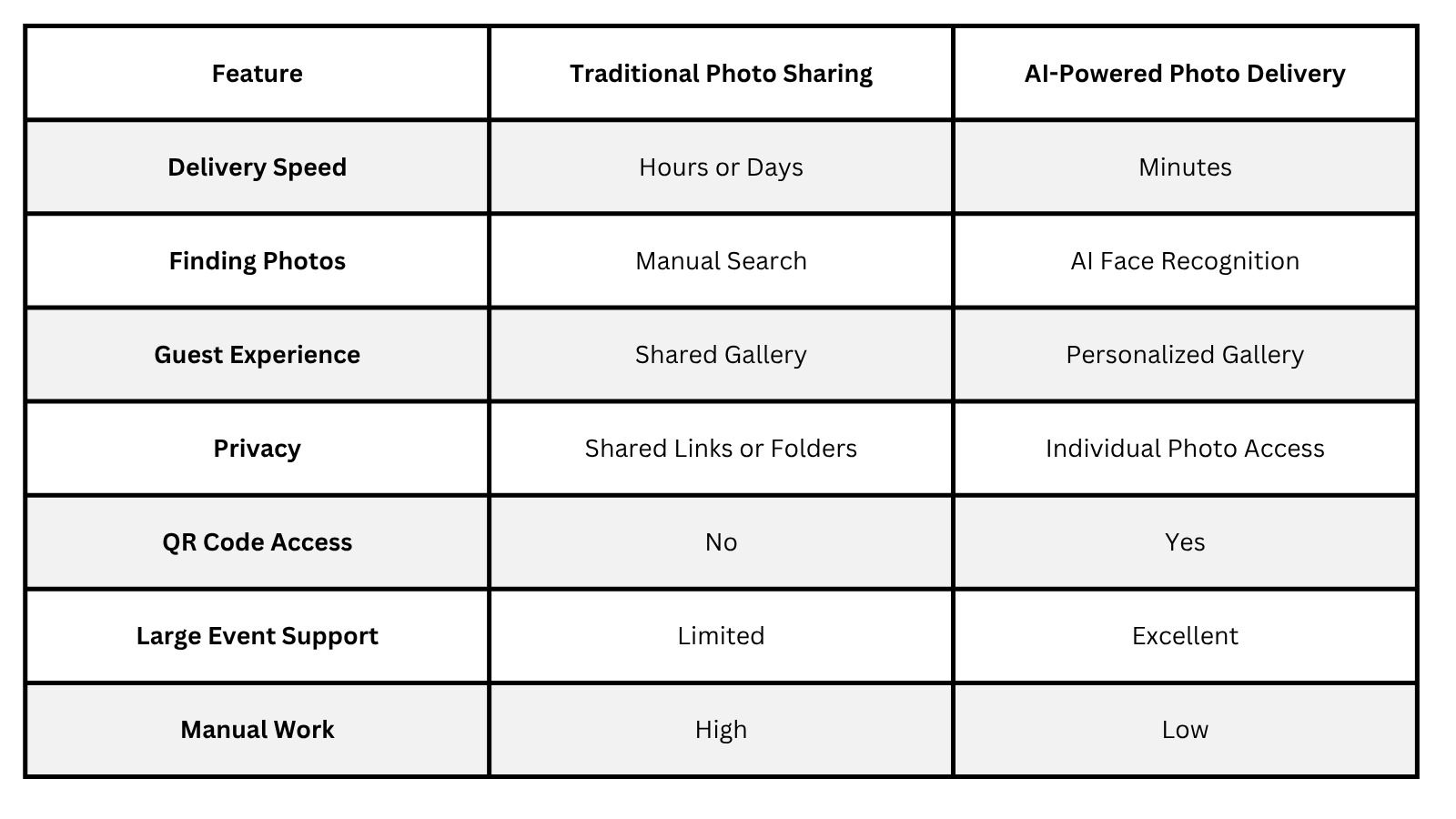
What Is Traditional Photo Sharing?
Traditional photo sharing refers to manually delivering event photos using cloud storage platforms or messaging applications. Photographers usually upload photos to services like Google Drive or Dropbox and then share the link with clients or attendees. Others use WhatsApp, email, or USB drives to distribute images.
This approach works well for smaller events with fewer guests and photos. However, when an event generates thousands of images, managing folders, creating links, and responding to guest requests become increasingly difficult.
Guests often have to browse large galleries, zoom into photos, or download multiple images before finding themselves. This process not only consumes time but can also reduce the overall event experience.
Pros
- Familiar workflow
- Easy to use
- Suitable for small events
- No specialised software required
- Affordable for individual photographers
Cons
- Guests manually search through galleries
- Time-consuming for photographers
- Slower delivery process
- Limited privacy
- Difficult to manage large events
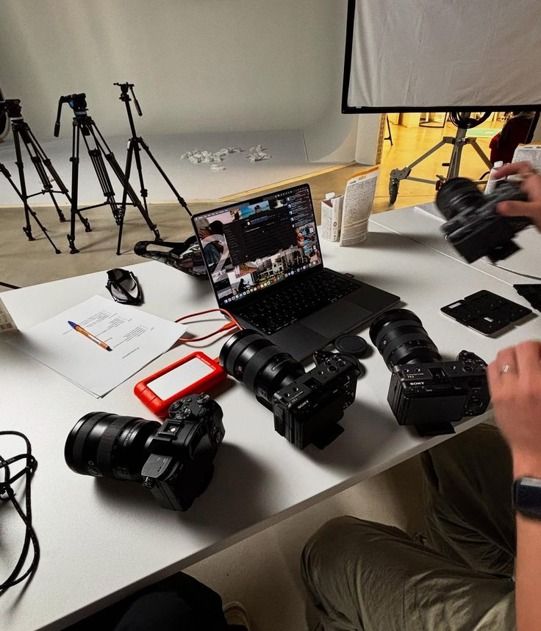
What Is AI-Powered Photo Delivery?
AI-powered photo delivery uses artificial intelligence and facial recognition technology to automate photo distribution. Instead of searching through hundreds of event photos, attendees simply scan a QR code, upload a selfie, and allow the AI to identify matching faces.
Once the AI completes the search, attendees receive a private gallery containing only the photos they appear in. The entire process takes only a few minutes and requires minimal effort from both photographers and guests.
This modern approach significantly reduces manual work while creating a personalised experience that today's event attendees expect.
Pros
- Instant photo delivery
- AI face recognition
- Personalised photo galleries
- QR code access
- Improved privacy
- Less manual effort
- Better attendee experience
Cons
- Requires internet connectivity
- Depends on accurate facial recognition
Traditional Workflow vs AI-Powered Workflow
The biggest difference between these two methods lies in the workflow.
Traditional Workflow: The photographer uploads thousands of images to cloud storage, organises folders, creates sharing links, and sends them to attendees. Guests then browse through large galleries to locate their own photos. If they cannot find them, they often contact the photographer for assistance.
AI-Powered Workflow: The photographer uploads event photos once. Guests scan a QR code, upload a selfie, and the AI automatically identifies matching images. Within minutes, each attendee receives a personalised gallery without any manual searching.
The automated workflow saves valuable time while reducing repetitive tasks for photographers.
Guest Experience
Modern event attendees expect convenience. Waiting several days for photos or searching through hundreds of images no longer provides the best experience.
Traditional photo sharing often feels frustrating because guests need to scroll through entire galleries before finding their own photos.
With AI-powered photo delivery, the experience becomes much simpler.
Guests only need to:
- Scan a QR code
- Upload a selfie
- Receive a personalised gallery
- Download and share their photos instantly
This personalised experience increases guest satisfaction while encouraging social sharing immediately after the event.
Why Choose AI-Powered Photo Delivery?
- Instant photo delivery: Guests receive their photos within minutes instead of waiting for days.
- AI face recognition: Automatically finds and delivers only the photos each attendee appears in.
- Personalised galleries: Every guest gets a private gallery tailored to them.
- QR code access: Simply scan a QR code and upload a selfie to access photos instantly.
- Enhances guest experience: A fast and seamless process increases attendee satisfaction.
- Improves privacy: Guests only access their own photos instead of browsing shared galleries.
- Boosts social media sharing: Guests can quickly download and share photos while the event is still fresh.
Final Verdict
Traditional photo-sharing methods have been reliable for many years and remain suitable for smaller events where managing photos is relatively simple.
However, as events become larger and guest expectations continue to rise, manual photo sharing becomes increasingly time-consuming and less efficient. Searching through hundreds of photos, managing cloud folders, and responding to individual requests can quickly become overwhelming.
AI-powered photo delivery offers a modern solution by automating photo discovery through facial recognition, providing private galleries, and delivering photos within minutes. It not only saves valuable time for photographers but also creates a smoother and more engaging experience for event attendees.
Publish on:
Written By
Anjali K V
Digital Marketer
Subscribe to our newsletter
Publish on:
Written By
Anjali K V
Digital Marketer